
Polyamide: An Outstanding Engineering Plastic
author: DJ-03
2025-01-07
Polyamide: An Outstanding Engineering Plastic
Abstract: This article elaborates on polyamide in detail, covering its definition, synthesis methods, performance advantages, wide range of application fields, and development prospects, demonstrating its crucial position in the field of materials.
Polyamide, commonly known as nylon, is a general term for thermoplastic resins with repeating amide groups (—CONH—) in the main molecular chain.
-
Definition and Synthesis
- Definition: It refers to the general term for thermoplastic resins that have repeating amide groups (—CONH—) on the main molecular chain.
- Synthesis: It is usually synthesized by the polycondensation of a diamine and a dicarboxylic acid or by the self-polymerization of a lactam. For example, nylon 66 is obtained by the polycondensation of adipic acid and hexamethylenediamine. This precise chemical synthesis endows it with a unique molecular structure.

-
Performance Characteristics
- Excellent Mechanical Properties: It has high strength and high toughness. Its tensile strength is remarkable, enabling it to withstand relatively large external forces. In the manufacturing of industrial parts, it can replace metals. For instance, it is used to make gears, bearings, etc., which are durable.
- Outstanding Wear Resistance: It has a low surface friction coefficient and wears slowly under long-term friction. It is often used to make components that require frequent sliding or rotation, such as zippers and pulleys in daily necessities.
- Good Chemical Stability: It is resistant to the erosion of many chemical reagents and can maintain stable performance under certain acid-base environments. It is suitable for chemical pipelines and the lining of storage containers.
- Reasonable Thermal Stability: Different types have different heat-resistant temperature ranges, and generally, they can meet the requirements of conventional industrial production and short-term use in some high-temperature environments.
-
Application Fields
- Automotive Manufacturing: It is used for parts around the engine and interior components of the vehicle body. While reducing the weight of the whole vehicle, it ensures reliability, improves fuel economy, and enhances the comfort inside the vehicle.
- Electronics and Electrical Appliances: It is used to make electrical appliance shells, connectors, etc. Relying on its insulating properties and mechanical properties, it guarantees the safe and stable operation of electrical appliances and adapts to the complex internal structure requirements.
- Textile Industry: As a raw material for synthetic fibers, the nylon fibers made from it have strong wear resistance and good elasticity. They are widely used in clothing and home textiles, such as outdoor clothing and silk stockings.
- Aerospace: Special specifications of polyamide are used to make aircraft components and satellite parts, meeting the stringent requirements of lightweight and high performance and facilitating space exploration.
-
Development Trends
- High-performance: Research and development of new polyamide varieties are being carried out to improve their performance in high-temperature resistance and extreme environments, expanding the application boundaries to meet the needs of frontier fields such as deep-sea exploration and core components of new energy vehicles.
- Environmental Protection and Sustainability: Exploration of the synthesis pathways of bio-based polyamide is underway, utilizing renewable resources, reducing dependence on petrochemical raw materials, and reducing carbon emissions during the production process, in line with the trend of green development.
- Composite: It is combined with other materials to combine their respective advantages and create new materials with multiple excellent properties, injecting new impetus into high-end manufacturing.
An Introduction to Polyethylene: An Excellent General-purpose Plastic
Introduction to Foam Plastics
Related Article

This article analyzes the prospects of the custom parts industry from three aspects: market demand, technological innovation, and challenges and opportunities, with specific cases to illustrate its development trends.
Analysis of the Prospects of the Custom Parts Industry

This article details CNC precision technology, covering its definition, applications in aerospace and electronics, advantages like high precision and automation, and its promising future in the manufacturing industry.
CNC Precision Technology: The Core Code of Modern Manufacturing and Its Infinite Potential
This part focuses on the shipbuilding industry, presenting a case of CNC technology application in the processing of large - scale ship propellers. It showcases how CNC technology addresses challenges in this field, improving processing efficiency and product quality, thus highlighting its significance in ship manufacturing.
CNC Technology Application Cases (Part 2)
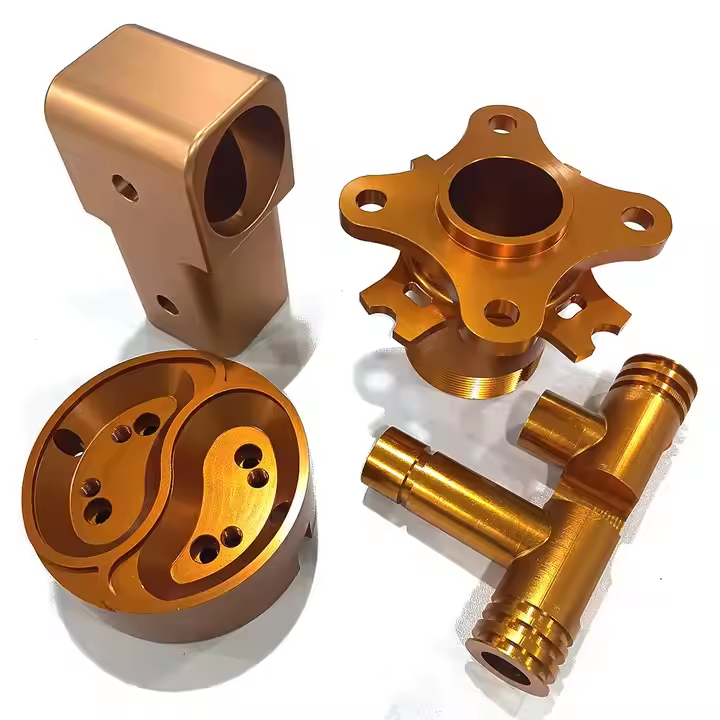
This article focuses on the medical device manufacturing and 3C product manufacturing fields. Through specific cases, it elaborates on the remarkable achievements of CNC technology in manufacturing complex and precise components and improving product quality, demonstrating its crucial role in related industries.
CNC Technology Application Cases (Part 1)