
Aluminum Alloy Parts
author: DJ-03
2024-12-24
Aluminum Alloy Parts
Abstract: This article focuses on aluminum alloy parts, elaborating on their characteristics, manufacturing processes, demonstrating their applications in multiple fields, analyzing challenges and prospects, so as to provide references for relevant research and applications.
I. Introduction
Aluminum alloys stand out in the field of materials due to their outstanding properties. The parts made of aluminum alloys are widely used, laying the foundation for the lightweight and high-performance of products in various industries.
II. Characteristics of Aluminum Alloys
- Low Density and High Strength: The density of aluminum alloys is approximately 2.7 - 2.9 g/cm³, which is much lower than that of steel. After alloying and heat treatment, the tensile strength can exceed 500 MPa, and some high-strength aluminum alloys can even reach more than 700 MPa, meeting mechanical requirements.
- Excellent Corrosion Resistance: The aluminum oxide film on the surface isolates from corrosion. In chlorine-containing environments such as the marine environment, the corrosion rate is much lower than that of carbon steel, ensuring long-term service stability.
- Good Thermal and Electrical Conductivity: The thermal conductivity is 100 - 200 W/(m·K), several times that of steel. The electrical conductivity is also good, making it suitable for parts related to heat dissipation and power transmission.
III. Manufacturing Processes of Aluminum Alloy Parts
- Die Casting: Liquid aluminum alloy is injected into the mold cavity at high pressure. It is suitable for producing complex, thin-walled parts in large quantities, such as automobile engine blocks. The production efficiency is high, but it is prone to porosity and requires subsequent treatment.
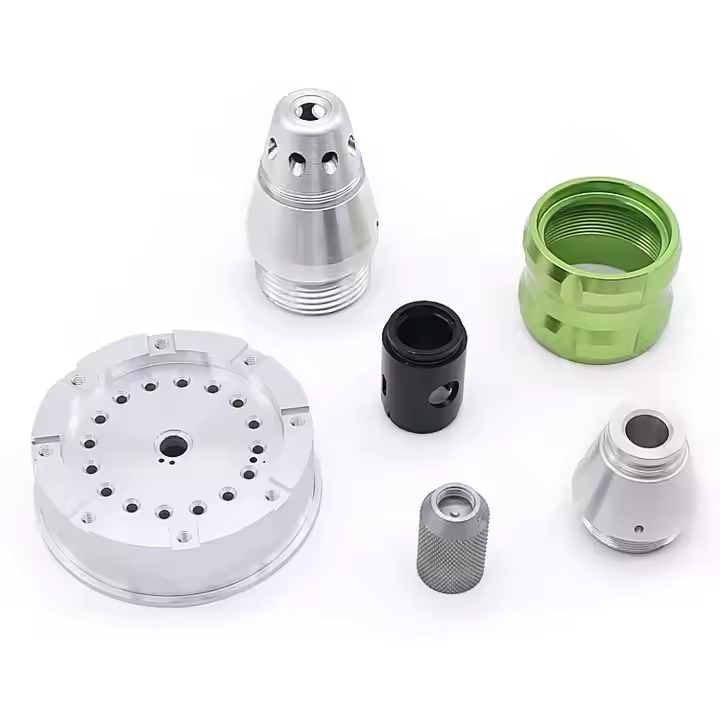
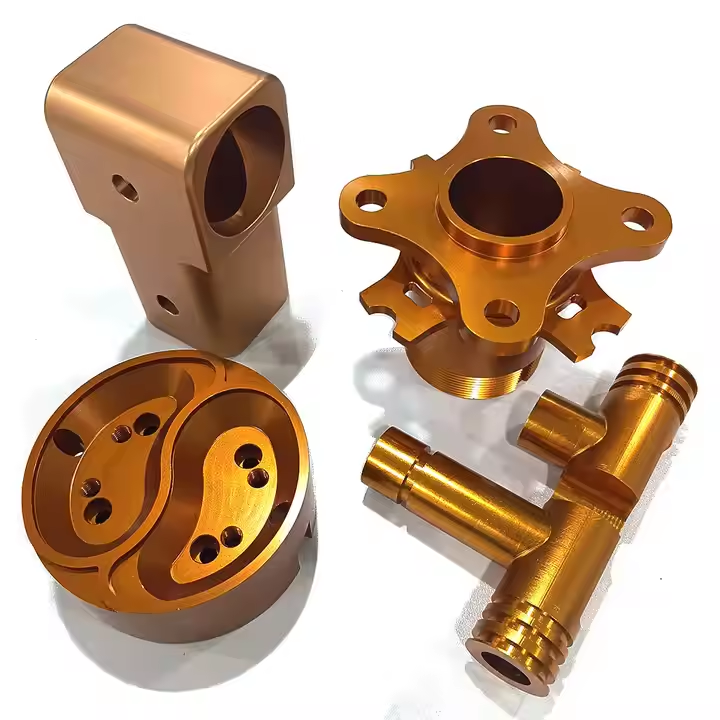
- Machining: For parts with extremely high precision and special structures, such as aero-engine blades, CNC milling, turning, grinding and other methods are used for processing. The machining accuracy can reach the micrometer level, but the cost increases with the improvement of precision.
- Forging: The aluminum alloy ingot billet is heated and then subjected to pressure to cause plastic deformation. It is often used to manufacture parts with large load-bearing requirements, such as aircraft landing gears. It can refine the grain structure and improve the performance, but the mold cost is high and the shape complexity is limited.
IV. Application Fields of Aluminum Alloy Parts
- Aerospace: Aluminum alloys are widely used in aircraft fuselages, satellite components and so on. They reduce weight while maintaining strength, helping the aerospace exploration achieve lightweight.
- Automotive: Aluminum alloys are widely used in engines, vehicle bodies, wheels and so on. The weight reduction of the whole vehicle improves fuel economy and handling performance.
- Electronics: Radiators and shells of mobile phones and computers are mostly made of aluminum alloys, which have good heat dissipation and also possess the functions of aesthetics and electromagnetic shielding.
V. Challenges and Prospects
Currently, aluminum alloy parts face challenges such as fluctuations in raw material prices, high costs of preparing high-performance alloys, and difficulties in balancing the precision and efficiency of forming complex shapes. In the future, it is necessary to develop new alloy systems, integrate additive manufacturing with traditional processes, and utilize intelligent manufacturing to promote industrial upgrading.
Main factors that affect CNC machining accuracy
Specific process of chemical deburring
Related Article

This article analyzes the prospects of the custom parts industry from three aspects: market demand, technological innovation, and challenges and opportunities, with specific cases to illustrate its development trends.
Analysis of the Prospects of the Custom Parts Industry

This article details CNC precision technology, covering its definition, applications in aerospace and electronics, advantages like high precision and automation, and its promising future in the manufacturing industry.
CNC Precision Technology: The Core Code of Modern Manufacturing and Its Infinite Potential
This part focuses on the shipbuilding industry, presenting a case of CNC technology application in the processing of large - scale ship propellers. It showcases how CNC technology addresses challenges in this field, improving processing efficiency and product quality, thus highlighting its significance in ship manufacturing.
CNC Technology Application Cases (Part 2)
This article focuses on the medical device manufacturing and 3C product manufacturing fields. Through specific cases, it elaborates on the remarkable achievements of CNC technology in manufacturing complex and precise components and improving product quality, demonstrating its crucial role in related industries.
CNC Technology Application Cases (Part 1)